Mask Italia: Importer of Handmade Italian Masks
The use of masks during the life of the Venetian Republic remains one of mankind's notably eccentric practices. Indeed, masks have been worn in cultures throughout the world for thousands of years, but perhaps never with such fervent pageantry as in Venice.
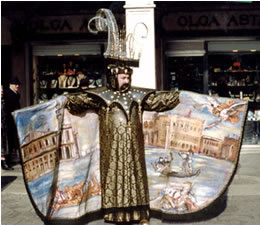
 For approximately eight hundred years, the Republic enjoyed a position of unrivaled superiority. Considered a breed apart from its European cousins, Venice was unquestionably the most extravagant, most beautiful state on the Continent. The shipyards were capable of turning out a battleship every thirty days and employed 15,000 men (in a state with a scarce 150,000 people). The routes of trade under the Republic's control extended all the way to Constantinople and beyond in the form of varied and extensive caravans, sultanates, and "friends". The Republic did not hold these routes uncontested for any long stretches of time - it was under constant duress from rival states. But hold them it did. As a result, as Marco Polo said, "All the gold in Christendom flows through the hands of the Venetians."
Unlike the vast majority of their counterparts in contemporary European nations, each citizen in Venice enjoyed a high standard of living. Everyone was part of the great economic machine that was the Republic. Venice was capitalizing on its position, on its gains, long before its contemporaries had realized the value of a market economy. With a level of social wealth unequaled since, the citizens of Venice developed a unique culture - one in which the concealing of the identity in daily life became paramount to daily activity. Part of the secrecy was pragmatic: there were things to do, people to see, and perhaps you might not want others to know what deals you were cutting. After all, the city is relatively small.
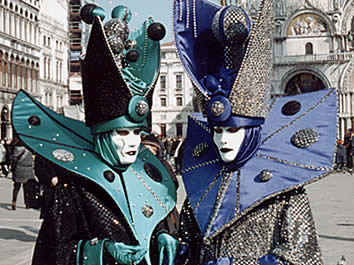
 Additionally, the masks served an important social purpose of keeping every citizen on an equal playing field. Masked, a servant could be mistaken for a nobleman - or vice versa. State inquisitors and spies could question citizens without fear of their true identity being discovered (and citizens could answer without fear of retribution). The morale of the people was maintained through the use of masks - for with no faces, everyone had voices.
As a result of the concealment of identity, however, people naturally found themselves taking advantage of the situation. The society grew ever more decadent. The immense amount of travelers coming through the city meant that sexual promiscuity was commonplace and acceptable. Gambling went on all day and night in the streets and houses, even in convents. Women's clothing became more revealing; homosexuality, while publicly condemned, was embraced by the populace. Even the nuns and monks of the clergy, bejeweled and dressed in the latest imported creations, wore masks and engaged in the same acts as the majority of their fellow citizens. Rome turned a blind eye, as long as the Republic continued to make generous donations.
The Republic fell into a state of luxury, indolence, and moral decay. Eventually the wearing of masks in daily life was banned and limited only to certain months of the year. During the last year of the Republic's existence, this period extended for over three months from December 26. It was gradually shortened into the week-long festivities that now comprise Carnevale, elsewhere known as Mardi Gras.
The Republic's long, sinuous spiral into legendary history came slowly. With the advent of new sea routes skating Africa, Venice lost its monopoly on Eastern trade. The Republic had grown somewhat complacent about maintaining its varied Mediterranean colonies - most were overtaken by the Ottoman Empire. The British and Dutch were rising to the challenge of the New World - something which Venice in its protected Sea was unable even to imagine. In response to the paradigm shift, Venice went on a two hundred-fifty-year bender - one that would end with Napoleon sanctimoniously handing over the dissolute Republic to Austria.
For questions about the history of specific masks please contact us at (504) 598-1998.
SITE MAP | CONTACT US | PRESS | FAQ | ABOUT OUR MASKS
© 2010 Mask Italia